Almighty Effluent Treatment Machine (AETM)

  • Home
  • Almighty Effluent Treatment Machine (AETM)

Almighty Effluent Treatment Machine (AETM)

Background of the Invention

The environmental pollution created by industrial effluent and municipal sewage has been a serious concern in the past few decades. Most industries discharge their huge volume of effluent to the environment without following the stipulated norms and standards. The growing urbanization and increased living standards of people cause huge generation of municipal sewage, which poses detrimental impact on the environment. On the other hand, the world is facing severe water crisis both in domestic and agricultural sectors. These issues are being put under top priority in the global sustainable development goals. A viable solution to this crisis is to adopt efficient and sustainable methods of wastewater treatment and recycling. In the conventional wastewater treatment method, the effluent is exposed to open air for a long period of time in large on-ground pits constructed over a large area. This system is highly expensive, time-consuming, and environmentally unfriendly; it also requires continuous monitoring throughout the process. This situation calls for off-ground, compact, efficient, rapid, affordable, user-friendly, and sustainable effluent/sewage treatment technologies. By addressing this challenge, the Almighty Engineering team has developed our ground-breaking off-ground technology named Almighty Effluent Treatment Machine (AETM) with the above features.
CALL FOR CONSULTATION

+91 9025040128
+91 9944786096

AETM Review Team

Dr. H. Kharkwal, Joint Director, Ministry of Environment, Forests and Climate Change, Govt of India
Dr. Dutta, Scientist D, Department of Scientific and Industrial Research (DSIR), Govt of India
Dr. Arindam Basu, Director, Northern India Textile Research Association (NITRA), Ministry of Textiles, Govt of India
Dr. Prakash Raj, Director, The South lndia Textile Research Association (SITRA), Ministry of Textiles, Govt of India
Dr. Venkatachalam, IAS, Textile Department, Govt. of Tamil Nadu
Dr. T. Selvaraj, Professor, Department of Production Engineering, NlT Trichy, Govt of India
Dr. Chellamani, Ex- Director, SITRA, Coimbatore
Dr. Karthikeyan, Ex Member Secretary, Tamil Nadu Pollution Control Board (TNPCB), Govt. of Tamil Nadu
Dr. Vijaya Lakshmi, Environment Training Institute, TNPCB, Chennai
Mr. K.K. Sasidharan, The Honorable Justice
Dr. S. A. Hipparagi, Scientist 'D', Central Silk Technclogical Research Institute, Central Silk Board, Bangalore, Ministry of Textiles, Govt. of lndia
Dr. S. Sivakumar, Head -.Textile Chemistry, SITRA, Coimbatore
Mr. V. Subbaiah, Programme Coordinator, TREC-STEP, Trichy
Mr. R. J. Narayanan, Finance & Admin Officer, TREC - STEP, Trichy
15.Mr. Shankar, IAS, Industries Department. Govt. of Tamil Nadu
Mr. Jawahar, TREC-STEP, Executive Director, DSIR, Trichy
Dr. Jaganathan, Scientist – D, Central Silk Technological Research institute, Central Silk Board, Bengaluru. ministry of textiles, Govt of India
Dr. Indumathi, Associative Professor, Civil and Water Resource Department, IIT Chennai
Mr. Paneer Selvam, Chairman, Dept. of Mechanical Engineering, NIT Trichy
Mr. Rama Kalyan, Chairman, Dept. of Instrumentation and Control Engineering, NIT Trichy
Ms. Vijaya Lakshmi, District Environment Engineer, Madurai District, TNPCB
Why AETM Technology?

Various industries produce effluents that cause land and air pollution. To save water resources and control land pollution, Government has setup some rules for the safe effluent discharge to land and other water resources. While most large-scale industries have their own treatment plants, the small and medium scale industries find it unaffordable. Consequently, the Government has come up with the solution of Common Effluent Treatment Plant (CETP).  Accordingly, a minimum of 10 small and medium scale industries are combined to set up CETPs in government-approved areas.  The treated effluent can be either disposed of or reused. However, CETP has the following drawbacks

 To overcome these drawbacks, AETM has been developed by applying 4R’s (Reduce, Reuse, Recycle and Recover), and it offers the following advantages over the existing on-ground technologies:

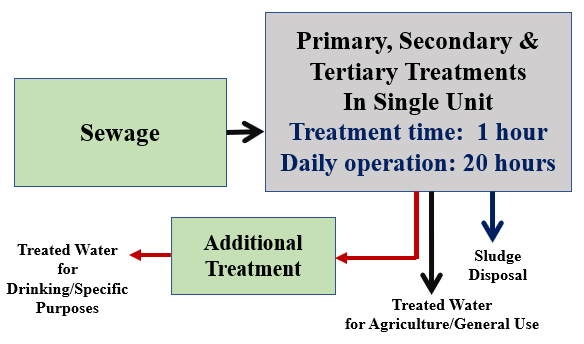
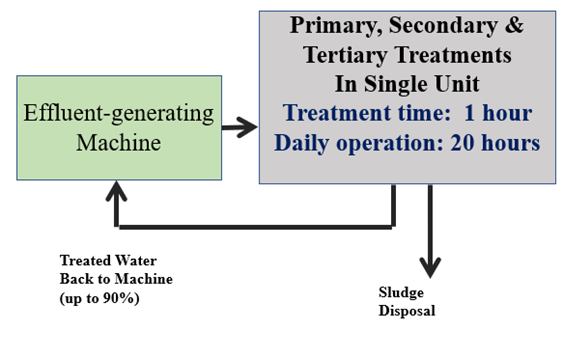
Fully automatic: the primary, secondary, and tertiary treatment stages are integrated into a single automatic unit that is operated through an electronic control system
Off-the-ground: large pits on the ground in the conventional plants are fully eliminated
Works in both batch and continuous modes
Portable, plug-n-play type
Can be customized for any effluent-generating equipment
Can be customized to treat any type of wastewater (domestic, municipal, industrial, or petroleum refinery)
60% space-saving
Ensures up to 90% reusability of the treated effluent, particularly in the effluent-generating equipment in various industries
The system can be designed to deliver clean water for agriculture or drinking
Fully sustainable
Rapid and user-friendly
No skilled workers are needed for operation and maintenance.
Suitable for small, medium, and large-scale industries
Full compliance with the national global regulations and standards.
Extremely affordable cost compared to the existing practices.

Salient Features of AETM

Untitled design (6)
User-friendliness
Till today, effluent treatment processes need skilled labours to operate the treatment plants. However, our AETM makes the entire operation simpler, which helps even a non-technical person can operate it easily with the help of inbuilt water parameter sensors, controllers, and pre-programmed chemical dosage and processing commands based on the effluent characteristics

MicrosoftTeams-image
Automation
Fully automatic water treatment machineries are available in the market: for example, auto electro oxidation machine, auto UV disinfection unit, and auto reverse osmosis and membrane process units. Our AETM integrates all the four (preliminary, primary, secondary, and tertiary) stages of treatment processes under a single auto control unit and performs the treatment either in batch-wise or continuous mode as per the customer requirement
Untitled design (7)
Quantity
The conventional effluent treatment plants (ETPs) are generally designed to handle large quantities of effluent. For instance, a minimum of 4 to 5 MLD (million litres per day) is common in India. On the other hand, the effluent discharge from small and medium scale industries ranges from 100KLD to 2MLD, so ETPs are not economic for them. As already mentioned, this problem is currently solved by CETP connected to several industries. The main drawback of CETP is the need for shutting down of all the connected industries in case of a maintenance/shutdown of CETP. However, our AETM can effectively solve this problem as it can be designed to handle small quantities ranging from 1 KLD (kilo litres per day). Consequently, each industry can independently operate our AETM according to their necessity
Untitled_design__8_-removebg-preview
Ease of Maintenance
Most CETPs are not efficient for continuous operation and become non-functional after some period of operation, which causes shutdown of the plant for maintenance. This affects the functioning of all the connected industries as there is no substitute plant available for them. This problem is effectively solved in our AETM by giving importance to the maintenance and service of the machinery. After each treatment process, AETM automatically cleans the tanks and alerts periodically about the required maintenance. We can design single AETM up to 50 KL per Unit. For 1MLD effluent treatment, we will increase the number of AETM Units and performs the treatment separately. Hence, failure of one unit does not affect operation of the other units
Cost Reduction
AETM consumes lower space, power, and chemicals for the treatment processes, which reduces the financial burden of the end users and ensures eco-friendly plant operation. The total cost of installation, operation, and maintenance of AETM is almost 50% less than that of a comparable CETP
Process Upgradation
A particular CETP is designed and operated for common effluent characteristics and for a fixed range of quantity. The plant gives its best performance only when it operates with the designed effluent characteristics and quantity. However, the effluent characteristics and quantity can vary according to the changes in manufacturing processes and production rate in the industry. Unfortunately, upgradation of CETPs according to such changes in the industry is almost impossible. This challenge has been addressed in our AETM by allowing easy upgradation of the process and capacity. If the quality of the effluent water varies due to the new toxic chemicals, we can recheck the quality and re-design AETM with minimal modifications for better efficiency, which is not possible with CETPs
AETM Design Considerations

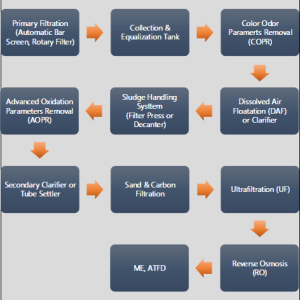
Quality: The treatment processes are designed after testing the effluent/sewage sample characteristics. The treatment processes include the following four stages:

Quantity: The industrial effluent generated per day (or flow rate) helps to determine the size of the AETM for achieving the required quantity of treated water.

Cost: Since the costs of fabrication, installation, operation and maintenance are drastically reduced, our AETM technology can save about 50% compared to the conventional on-ground treatment methods.

Steps in AETM Design & Delivery

AETM Municipal Sewage Treatment

AETM Industrial & Oil Refinery Effluent Treatment

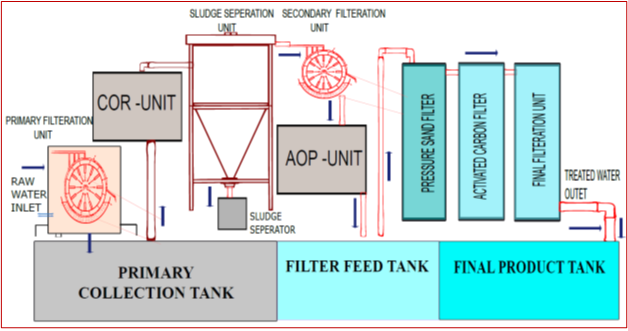
AETM Basic Layout

AETM Zero Liquid Discharge (ZLD) Process

AETM Zero Liquid Discharge (ZLD) Process
AETM Treatment Scope (BEFORE RO)

(Additional parameters will be considered depending on the effluent characteristics and client requirements)

Parameter Input Output
pH 10-12 mg/l Neutral
COD Up to 50000 mg/l Less than 250 mg/l
BOD Up to 7500 mg/l Less than 30 mg/l
TDS Up to 20000 As per raw effluent TDS
TSS Up to 1200 mg/l Less than 30 mg/l
Total Hardness 1500 mg/l Less than 300 mg/l

AETM Case Study 1: Textile & Dyeing Effluents

Our AETM technology has unique features that provide compact effluent treatment solutions to all kinds of effluents. Though the nature of effluents from different industries varies depending on the processes and chemicals used, the effluent has few common characteristics. For instance, the textile and dyeing units’ effluent has a characteristic color along with high chemical oxygen demand. AETM provides technologically sound, and economically viable automated smart solution for treating the textile and dyeing industry effluents and offers the following solutions:

Removal of color and odor
Removal of hardness and chemical oxygen demand (COD)
Minimal sludge volume
Optimal chemical usage
90% water reuse

AETM uses the following treatment methodologies for textile and dyeing effluents:

Preliminary treatment: Screening
Primary treatment: COPR process
3.Secondary treatment: AOPR method
Tertiary treatment: Final filtrations & reverse osmosis (RO) membrane process

Textile and dyeing raw and treated effluent characteristics

Parameter Characteristics Permissible Limit as per Govt. Norms
Effluent Treated Water
pH 9.71 6.6-7.5 6 – 8
COD mg/l 3200 100 250
BOD 600 20 50
TSS 350 15 100
Total hardness (ppm) 300 40 60
TDS 7800 100 2100
Color 640 5 15

The pH value is an indicator of acidity/alkalinity/neutrality. If pH lies in the range of 6.5 to 7.5, it is considered neutral. The input of the raw effluent was alkaline (pH>7), and upon treatment, the effluent has been neutralized with a pH of 7. The COD value has shown tremendous decrease from 3200 mg/l to 100 mg/l, while hardness has decreased from 300 ppm to 40 ppm. The results in Table 1 show the effectiveness of the AETM in treating the dyeing effluents. Our AETM technology can treat 25,000 liters – 2,00,000 liters of effluent per day

AETM Case Study 2: Municipal Sewage Treatment

The municipal sewage has a characteristic color, along with high chemical oxygen demand. AETM provides technologically sound, economic, and sustainable smart solution for treating the municipal sewage and offer the following solutions:

  • Removal of the color and odors from the municipal sewage
  • 90% water reuse

AETM uses following treatment methodologies for the municipal sewage:

  1. Preliminary treatment: Screening  
  2. Primary treatment: COPR process
  3. Secondary treatment: AOPR method

Tertiary treatment: Final filtrations & reverse osmosis (RO) membrane (if needed)process

Raw and treated sewage characteristics.

Parameter Characteristics Permissible Limit as per Govt. Norms
Sewage Treated Water
pH 7.71 6-7 6 – 8
Nitrogen as N 85 10 10
BOD 300 20 30
COD 650 150 250
TSS 350 20 25
Chloride 100 40 60
TDS 1200 100 2100
Oil & Grease 150 15 20
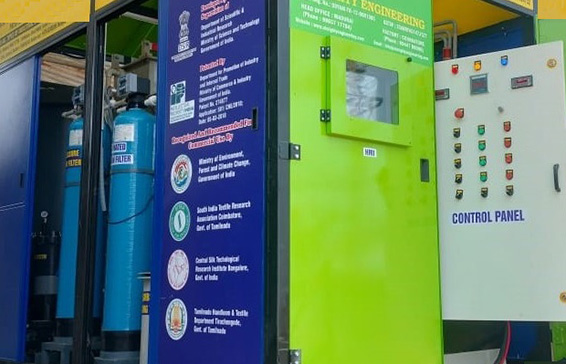
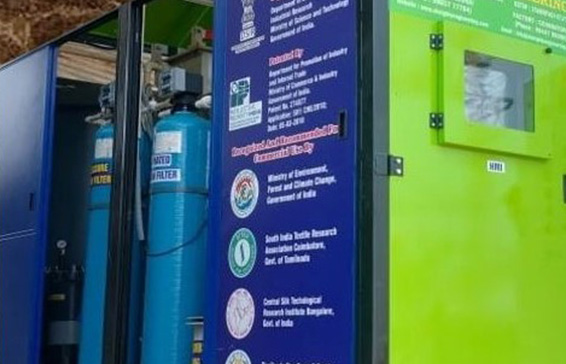
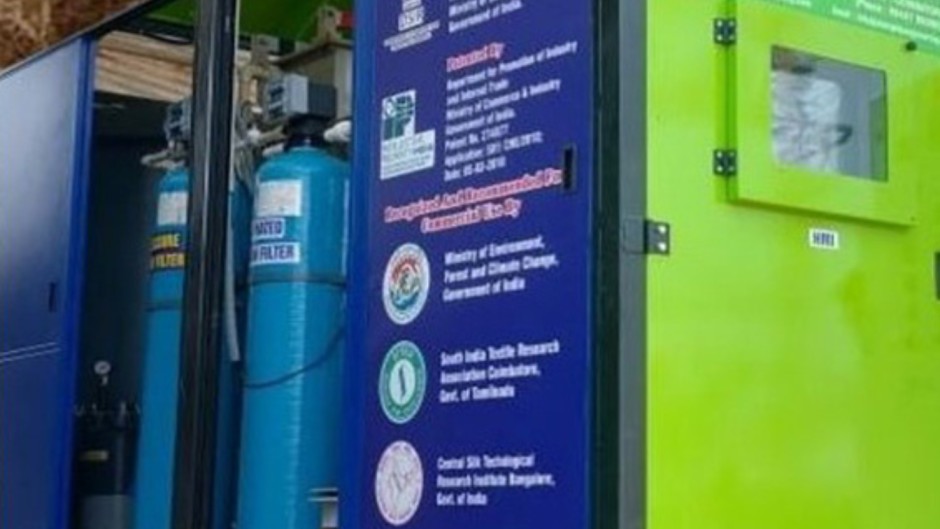
AETM Commercial Mobile Demo Machine

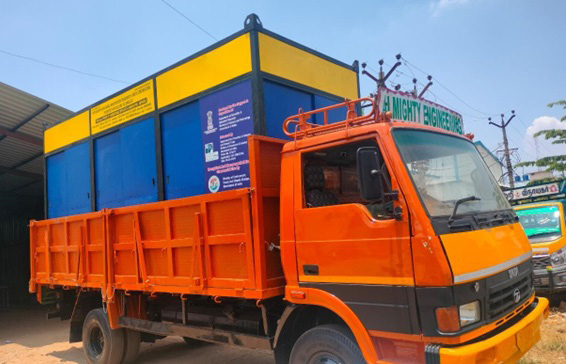
By considering the customers’ concern to see a demonstration of our treatment technology before placing an order, we have developed a 6KLD mobile demo unit that can travel to the customers’ location and facilitate an on-site demonstration. Our demo unit has successfully completed its first demo for a CETP at Erode, Tamil Nadu

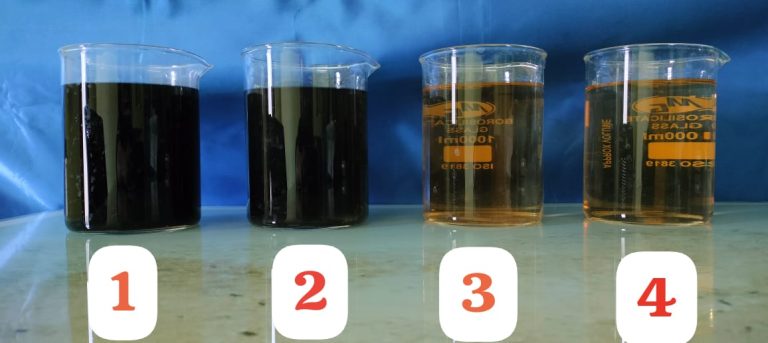
Comparison of Conventional & AETM Test Results

Conventional ETP Results

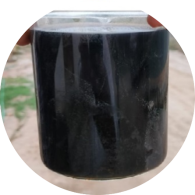
1.Raw dyeing effluent.

  1. Primary Clarifier Output: Chemical Coagulation (Lime, Ferrous, A. Poly, HCl).
  2. Secondary Clarifier Output: Aeration-Biological Method.
  3. After Sand, Carbon, and Ultrafiltration (UF) (before RO)


Main Problem:

Since the treated quality is very poor, using it as the first feed for the RO unit quires  daily cleaning and creates membrane chocking problem, leading to frequent membrane replacement

AETM Results

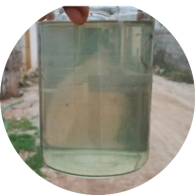
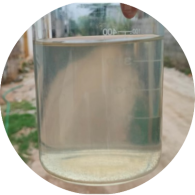
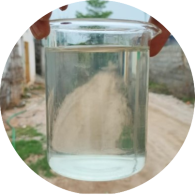
  1. Raw dyeing Effluent.
  2. COPR output: only 2 chemicals used (A. Poly & HCl)
  3. AOPR output
  4. Sand and carbon filtration output
  5. UF output (before RO)

Main Advantage:

Since the output quality is highly improved, there is no need for daily cleaning of the RO unit, and hence the issues of membrane choking and frequent replacement are solved